
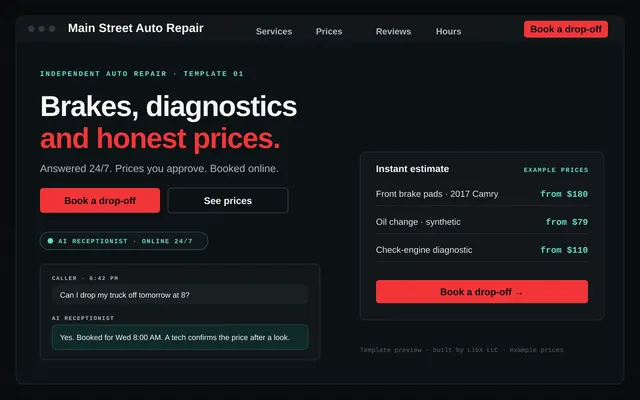
AI for entrepreneurs—available, effective, and accurate. Put the autonomy of your business in your hands. For twenty years a small business website worked like a paper brochure: someone found you on Google, waited for a slow page to load, filled in a contact form, and hoped you would call back. If you were under a car, on a roof, or in a treatment room, you didn't. That model is starting to fall behind. This report covers what replaces it between now and 2030.
1. From Chatbots That Chat To AI Staff That Do The Work
The first wave of AI for small business was the chatbot. It could answer "what are your hours?" but it could not quote a brake job, book an HVAC service call, or hold a slot for a facial. Worse, it made up prices. A shop owner, a plumber, or a med spa manager does not need small talk. They need the caller handled: a clear answer in dollars, from a price list the owner approved, and a booking on the calendar.
The next step is AI staff: a small set of AI roles—receptionist, follow-up, knowledge base, content—each with one job, each reporting to the owner. This is how LibX itself runs. Amrit Sharan, the founder, makes the decisions; the AI staff do the routine work and report back. The receptionist role works through a fixed set of steps:
- Understand the request: Reads the call or the website chat and picks out what matters—the vehicle and the symptom, the size of the house and the problem, the treatment and the preferred day.
- Quote only from approved prices: Pulls the number from the owner's price list, in US dollars. If a price isn't on the list, it says so and takes a message. It's set up to use only that list. It also says up front that it is an AI. For a med spa it never asks or answers health questions; it books the consultation and leaves the rest to the staff.
- Check the calendar: Looks at real availability and books the appointment. The caller hears "Tuesday at 10 works" instead of "someone will get back to you."
- Hand off to a human: Sends the owner a short email with the name, the job, the quoted range and the booked time, so the owner steps in only when a person is needed.
2. Why A Fast, Clean-Code Website Still Matters
An AI receptionist on your website cannot help a visitor who left before the page loaded. Many searches for "brake repair near me" or "AC not cooling" happen on a phone, often from a driveway or a parking lot on a weak signal. A heavy template full of plugins loads slowly, and the visitor goes back to the search results and calls the next shop on the list.
At LibX LLC, we write the whole site in plain, hand-written HTML with light assets. It loads fast on a phone, Google can read it, and ChatGPT can read it too, because every page carries JSON-LD and the site has a root-level llms.txt file.
Try Our AI Receptionist Here, Then Put It On Your Own Domain ($497 Setup)
Everything you see on this page—the fast clean-code site, JSON-LD @graph + SpeakableSpecification, and the AI receptionist you can test—is part of your $497 USD 7-step setup, plus $297/mo, month-to-month, cancel anytime. The setup is built in 72 hours once your info is in. If you don't approve it before launch, the full $497 comes back.
3. 2027 And Beyond: When The Customer's Own AI Does The Searching
Over the next few years, more of your customers will ask ChatGPT, Gemini, or the assistant on their phone to "find a shop near me that can do a timing belt this week," "get someone out for a leaking water heater today," or "book a facial for Saturday." Those assistants read websites the way a crawler does. A site with clean JSON-LD and a root-level /llms.txt is easy for them to read and pass on, and an AI receptionist that answers the call they place is the last step. A site that is a wall of images and scripts, with a contact form and no one picking up, is harder for them to use. That is the whole shift from 2026 to 2030: the website stops being a brochure and becomes the front desk.